Qmee: Paid Survey Cash Rewards
- 4.2
- Rating
- 1.00M
- Installs
- Free
- Price

 Analysis by App-foxy
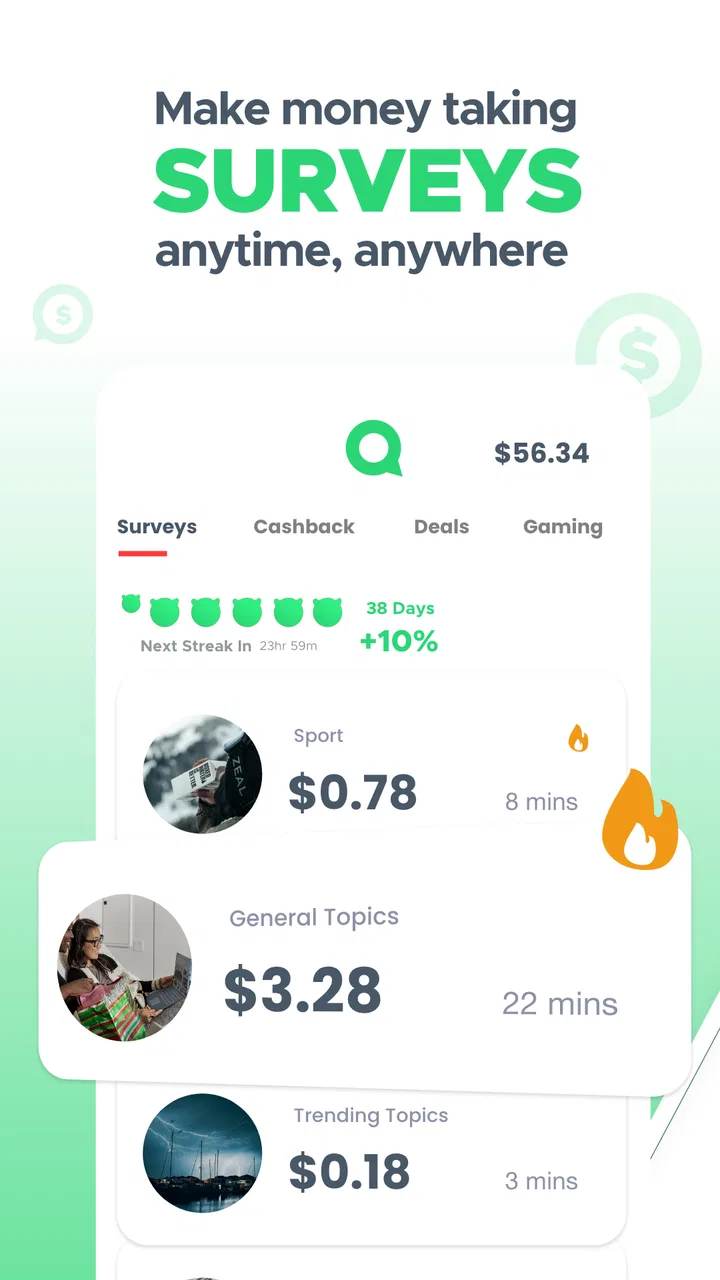
I approached Qmee as a small, practical way to use spare minutes rather than as a replacement for regular income. It belongs to the lifestyle category, is free to install, and comes from Qmee, a developer focused on paid survey rewards. The basic idea is easy to understand: open the app, look for an available survey, complete it, and build a balance that can be withdrawn through PayPal. That simplicity is the main reason it feels appealing during the first few days.
My honest view is more measured after the novelty fades. This is not an app I would open with the expectation of earning a dependable wage. I see it as a pocket-sized option for people who are comfortable answering market-research questions when opportunities happen to fit their profile. It can earn a lasting place on a phone, but only if you treat it as occasional spare-time activity and accept that the experience depends heavily on which surveys appear for you.
How Qmee Holds Up Beyond the First Week
I find that the longer-term test is less about how quickly the balance grows and more about whether the routine still feels comfortable. In this section, I look at the habits and small choices that can keep survey sessions from taking over spare time, including when it makes sense to leave an opportunity for another day. That leads naturally to a closer look at how the app works across different needs and settings.
You May Also Like

 Blood Strike: 2.5 Anniversary
Blood Strike’s Loadouts Turn Every Drop Into a Tactical Gamble
A close look at Blood Strike’s custom loadouts: how fast access to signature weapons reshapes its battle royale rhythm, rewards preparation, and narrows the gap between fights.

 Pandora - Music & Podcasts
Pandora’s Music Is Easy to Start, but Harder to Recover
Pandora’s strength is its low-effort path from a seed to a station. Its weak spot is how much confidence it asks you to place in connection, setup, and quiet recovery.

 8 Ball Pool
 Is Built on Rivalries, Rematches, and Routine
A close look at the rivalries, rematches, shared routines, and unanswered safety questions that turn a quick pool match into a persistent mobile community.

 Samsung Music
’s Quiet Strength Is Playing What You Already Own
Its reach comes less from spectacle than from dependable access to a personal library. That simplicity is both the app’s strongest retention engine and its ceiling.

 AccuWeather: Weather Radar
AccuWeather Review: A Quick, Clear Forecast for Everyday Decisions
For everyday plans, the best forecast is the one you can understand quickly. AccuWeather makes rain timing, radar, and local conditions easy to act on, with a few trade-offs.

 Hill Climb Racing
Why Hill Climb Racing Still Turns Crashes Into One More Run
A tiny car, a bumpy hill and one more upgrade: Hill Climb Racing keeps resurfacing because its simple chaos makes every near-miss feel personal.
More From Our News Desk



The first-week appeal is immediate and easy to understand
The strongest part of the early experience is the low barrier to entry. There is no purchase price to justify, and the app is rated for Everyone, which makes its purpose feel accessible to a broad audience. The interface concept is also straightforward: check for surveys, read the estimated opportunity, decide whether the task is worth your time, and work toward a cash reward.
That structure suits the odd moments that normally disappear from a day. I can imagine checking it while waiting for an appointment, sitting on public transport, or taking a short break between errands. The app does not need to become a major hobby to be useful. Its value comes from fitting into time that would otherwise produce nothing.
The first week can also create a misleading impression. New users are naturally curious, so they check more often and are more willing to try different surveys. That makes the app feel active and rewarding at first. Once the initial curiosity wears off, the important question becomes whether the available tasks are still worth opening the app for.
I recommend starting with a simple rule: never begin a survey without first deciding how much attention you are willing to give it. A short task may be suitable during a queue, while a longer questionnaire is a poor choice if you are distracted or likely to leave halfway through. This small habit prevents the app from turning spare time into frustrating time.
What the survey routine feels like in everyday use
Qmee works best when I think of it as a choice board rather than a scheduled job. I would open it, scan the available opportunities, and select only something that matches the moment. That mindset matters because the app’s usefulness is not just about the reward; it is about the relationship between the reward, the expected effort, and my current attention span.
A realistic scenario would be a commuter with ten quiet minutes before a train arrives. They might complete one suitable survey, close the app, and continue with the day. The same person could ignore it on a busy morning without feeling that they had missed a work shift. This flexibility is a genuine advantage over more structured side-income options, which usually demand a fixed schedule or a longer commitment.
There is also a practical benefit in being able to cash out through PayPal. For someone who already uses that service, the reward feels more useful than points locked inside a store-specific system. I would still view the balance as occasional spending money rather than something to budget around, but a familiar cash-out route makes the result easier to understand and use.
Why the early convenience does not guarantee lasting value
The main limitation appears when I stop judging the app by its novelty and start judging it by habit. Survey platforms depend on matching people with research opportunities. That means the number and suitability of tasks can change, and not every opening will be a good fit for every user. I would not install this expecting a constant stream of equally attractive surveys.
Some users will also find the screening process tiring. A survey can ask several questions before making it clear whether the respondent fits the intended audience. Even when this is normal for market research, it can feel inefficient if it happens repeatedly. The app is therefore better for patient users who can accept occasional dead ends than for anyone who wants every tap to lead directly to a completed reward.
This is one of the first trade-offs to understand: Qmee removes the financial barrier, but it cannot remove the uncertainty built into survey work. The free price makes trying it low-risk, yet free access does not mean every minute will be equally productive.
Month-to-month value depends on disciplined expectations
After the first month, I would judge the app by whether it has become a useful background habit without demanding too much attention. The best pattern is occasional checking, not constant refreshing. If I open it naturally during idle moments, complete surveys that seem worthwhile, and withdraw rewards when appropriate, it can remain a modest but pleasant addition to my routine.
The worst pattern is treating it like a daily obligation. Checking repeatedly can make the experience feel repetitive, especially when available surveys do not match your interests or when a questionnaire takes longer than expected. The reward alone may not compensate for that sense of chasing opportunities. A sustainable routine needs a stopping point.
My preferred approach would be to set a personal time limit for each session. For example, I might check once during a break and stop if nothing suitable appears. I would also avoid opening the app while multitasking. Survey answers are more likely to be careless when I am watching something else, and rushing defeats the point of earning a reward for considered participation.
Another useful habit is to separate “available” from “worth doing.” A survey being visible does not automatically make it a good use of time. I would consider its length, the level of concentration it seems to require, and whether I can finish without interruption. This simple filter is more important for long-term satisfaction than trying to complete every opportunity.
Who is most likely to keep using it
Qmee is a reasonable fit for people who enjoy lightweight tasks, have irregular pockets of free time, and prefer rewards that can move toward PayPal cash rather than remain as abstract points. Students, commuters, part-time workers, and people who spend time waiting may appreciate that it does not require a large block of uninterrupted time every day.
It can also suit someone who wants to test the survey-reward category without paying for access. The free model makes experimentation straightforward: install it, learn how the survey flow feels, and decide whether the available opportunities justify keeping it. Because the app has surpassed one million installs and holds a 4.2 average from around 112 thousand ratings, it has clearly attracted a substantial user base, although popularity should not be confused with guaranteed personal earnings.
I would be more cautious recommending it to anyone who needs predictable income. It is not the right tool for paying a bill on a schedule, replacing employment, or planning around a fixed monthly amount. Users who dislike answering personal preference questions, become annoyed by screening, or expect every session to produce a reward may also lose patience quickly.
The real maintenance burden is attention, not storage
From a maintenance perspective, the app is light in the sense that it does not need to become a central part of your digital life. The bigger burden is remembering to use it selectively and keeping expectations realistic. If I let it become another app I compulsively check, its small rewards can be outweighed by the time spent browsing for something worthwhile.
That is why I would place it in a low-frequency folder rather than on my main home screen. This is a surprisingly effective arrangement: the app remains available when I have genuine idle time, but it does not constantly compete for attention. Qmee works better as an optional tool than as a notification-driven routine.
Keeping the app updated is sensible because the current version is 3.8.27, but I would not interpret an update number as a promise of a particular earning experience. The important maintenance question is personal: does the app still provide enough useful opportunities for the time I spend with it? If the answer becomes no, removing it is more rational than forcing a habit.
I would also keep a basic mental record of why I open it. Am I using it during time that would otherwise be wasted, or am I interrupting more valuable activities to chase a small reward? That distinction protects the app’s usefulness. A survey completed during an unavoidable wait can feel worthwhile; the same survey chosen instead of rest, study, or focused work may not.
Where fatigue starts to build
The most obvious source of fatigue is repetition. Surveys often ask about preferences, habits, products, or opinions, and that format can become mentally flat when used too frequently. Even if each individual questionnaire is manageable, a long series of similar tasks can make the app feel like work without the structure or certainty of a conventional job.
Uncertainty adds another layer. I may open the app ready to participate and then find that nothing suits the time available. On another occasion, I may start optimistically and discover that the task requires more concentration than expected. These moments do not make the app defective, but they do limit how dependable the experience feels.
There is also a psychological trap in small rewards. Because each opportunity appears manageable, it is easy to continue for longer than planned. I would avoid making the balance itself the main motivation. Instead, I would set a clear purpose for the money, such as letting several small withdrawals accumulate for an occasional treat. That gives the activity a boundary and makes the result feel more tangible.
Privacy-conscious users should make their own comfort assessment before answering any survey. The app’s entire purpose involves sharing opinions and profile-related responses for research opportunities, so anyone uncomfortable with that basic exchange should skip it. No reward is worth ignoring your own boundaries. I would read each question carefully and avoid answering casually just to finish faster.
How it compares with ordinary alternatives
Compared with cashback apps, Qmee is more directly centered on answering surveys rather than receiving rewards for shopping activity. That makes it more accessible when I am not planning a purchase, but it also means the earning action is an active task. Cashback is often easier to leave running in the background of a purchase I already intended to make; a survey requires my time and attention.
Compared with microtask platforms, Qmee feels more approachable for casual use because the central activity is easy to recognize. Microtask services may offer a wider variety of assignments, but that variety can bring more complicated instructions or a steeper learning curve. I would choose Qmee when I want a simple survey session, not when I am looking for a broad freelance-work marketplace.
Compared with loyalty programs, the PayPal cash-out route is appealing because it is less tied to a particular retailer. On the other hand, a retailer’s loyalty scheme may be better for someone who already shops there regularly and can earn rewards without setting aside separate survey time. The better option depends on whether the user values flexibility or effortless accumulation.
Qmee’s advantage is therefore narrow but clear: it offers a low-cost way to turn selected idle minutes into a cash-oriented reward. Its weakness is equally clear: the user must decide repeatedly whether a particular survey deserves those minutes. That decision is the central experience, not a minor detail.
Practical ways to make the habit less tiring
I would begin by using the app only in predictable idle windows. A commute, a waiting room, or a quiet break gives the activity a natural limit. Opening it whenever boredom appears is more likely to create compulsive checking and disappointment.
Second, I would stop treating every survey as an invitation that must be accepted. Skipping an unsuitable task is part of using the app intelligently. If I am short on time, distracted, or already tired, I would leave it for another moment rather than forcing low-quality answers.
Third, I would protect the quality of my responses. Rushing through questions may make the experience feel faster, but it can also make the activity less satisfying and potentially lead to poor survey outcomes. A quiet setting and a clear time limit are a better combination than trying to answer while doing several other things.
Finally, I would review the habit after a few weeks. If Qmee is helping me use otherwise empty time and the PayPal rewards feel worthwhile, I would keep it. If I am checking constantly, feeling irritated, or sacrificing better uses of my attention, I would remove it without hesitation. The app should serve the routine, not control it.
The long-term verdict after the novelty fades
Qmee earns lasting space only as an occasional survey companion. I like the fact that it is free, easy to try, aimed at a broad audience, and connected to PayPal cash rewards. Its lifestyle positioning makes sense because it fits around daily life rather than requiring a formal schedule. For the right user, that flexibility is more valuable than a complicated collection of earning tools.
Still, I would not recommend it as a dependable income source. The changing suitability of surveys, the possibility of screening frustration, and the repetitive nature of questionnaires all become more noticeable over time. Anyone expecting consistent earnings or effortless rewards will probably be disappointed, while someone who sees it as a small option for spare minutes may find it worthwhile.
The app has been available since June 16, 2016, and its current release remains compatible with Android 7.0 and later. Those details make it accessible to many older Android devices, while the broad install base suggests that the concept has continued to attract attention. What matters more to me, however, is whether the individual experience remains comfortable and useful after the first burst of curiosity.
My recommendation is simple: try it if you can accept variable opportunities, protect your time, and genuinely prefer survey rewards over shopping-based or task-based alternatives. Skip it if you need certainty, dislike repetitive questions, or find yourself checking for rewards more often than you intended. Qmee is best when it stays small, optional, and honest about what it can provide: a way to make selected idle minutes feel a little more productive, not a substitute for reliable work.
FAQs for Qmee: Paid Survey Cash Rewards
01What is Qmee: Paid Survey Cash Rewards, and how does it work?
Qmee is a rewards app that lets you earn money by completing online surveys and, in some regions, participating in other optional activities such as shopping-related offers. After creating an account, the app matches you with available surveys based on your profile. Each survey displays an estimated reward and completion time, although availability and eligibility can change frequently.
02Can you really make money with Qmee, and how much can you earn?
Qmee can provide genuine cash rewards, but it should be viewed as a small side-earning tool rather than a dependable income source. Earnings depend on your location, demographic profile, survey availability, and how often you use the app. Some surveys pay only a modest amount, and you may occasionally be screened out after answering initial questions.
03How do you receive your rewards from Qmee?
One of Qmee’s appealing features is that it generally allows users to cash out without waiting for a high minimum balance, although available payment methods and rules may vary by country. Depending on your region, options can include PayPal, gift cards, or other supported services. Before completing surveys, check the current withdrawal requirements and account verification conditions.
04Is Qmee safe to use, and what personal information does it require?
Qmee requires profile information so it can match you with relevant market-research surveys. As with any rewards platform, you should review its privacy policy and understand how your responses and account details may be processed or shared with research partners. Download the app from an official store, use a strong password, and avoid providing information that a survey does not reasonably need.
05Why am I disqualified from Qmee surveys, and how can I find more opportunities?
Survey disqualifications are common because researchers seek specific audiences, and a survey may fill its quota while you are answering it. To improve your chances, complete your profile accurately, keep your demographic details consistent, enable appropriate notifications, and check the app regularly. Do not rush through questions or give contradictory answers, since low-quality responses can reduce future invitations.
Pros
- Multiple payout options
- including PayPal
- gift cards
- and charitable donations.
- No minimum cash-out threshold for several supported payment methods.
- Available in multiple countries with surveys tailored to your profile.
- Simple interface makes finding and starting surveys quick.
- Rewards can be earned from occasional web searches and shopping offers.
Cons
- Survey availability can vary greatly by location and demographic profile.
- Some surveys screen you out after answering several questions.
- Reward amounts are often small compared with the time required.
- Profile and activity data are collected to match advertising surveys.
- Certain payout options and offers may not be available in every country.

Qmee: Paid Survey Cash Rewards
Gallery